

The Durfee Mansion at St. John of Gods


- Details
- Category: Architecture
- Published on Thursday, 09 February 2012 00:29
- Written by Renee Montgomery
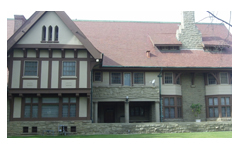
“It is probably the finest example of the purely English type of dwelling in this city,” the L.A. Times wrote in 1909 in a full page article marking the home’s completion.
The Durfee Mansion, located at 2425 S. Western Ave., just north of Adams Blvd., and set back off the street, sits on the grounds of the St. John of God Retirement and Care Center. The estate’s present pious purpose belies a colorful history, worthy of a Hollywood script.
The prestigious mansion was built in 1908 for Louisiana lumber magnate William Ramsey (born 1855) who sought a California retirement home for himself and his wife. Ramsey commissioned architect Fredrick L. Roehrig to design the three-story 42 room edifice in the Tudor Revival style. Now listed on the US Registry of Historic Places and designated as a L.A Historic-Cultural Monument, the impressive estate is known for its massive hall, living and dining room,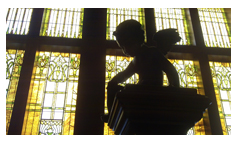 decorated with the mahogany paneling, dados, beams and window seats one would expect of a timber baron’s private residence. A nearly 2,600 square foot ballroom occupies the third floor.
Ramsey didn’t enjoy his estate very long however-- passing away within months after the home’s completion. The site was then leased to Rupert Hughes, a playwright and novelist successful for silent film screenplays. Under Hughes, the site became famous for its elaborate parties, including the likes of Samuel Goldwyn. It served as a popular movie locale, especially for wedding scenes featuring the mansion’s stunning staircase and entry with art glass and rich paneling. A Charlie Chaplain film numbered among the many projects using the site, until the property was sold in the early 1920s to William G. Durfee for the unheard of sum of $105,000. Durfee died a few years later of reputed food poisoning on a fishing trip and is buried at Rosedale Cemetery.
Paul Revere Williams
- Details
- Category: Architecture
- Published on Wednesday, 28 December 2011 22:25
- Written by Renee Montgomery
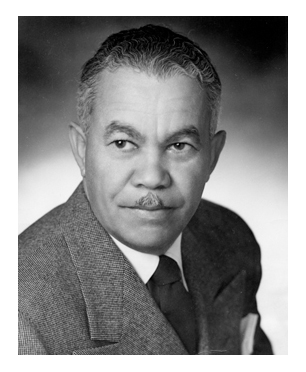 Mid-City is the proud location of a noteworthy example of local International-Moderne style in the personal residence of architect Paul Revere Williams, situated in Lafayette Square.
Known as “architect to the stars” Williams (1894-1980) was one of the city’s most successful and popular designers, building impressive homes, commerical and public buildings throughout Southern California.
In 1951 Williams designed a 4,400 square foot home at 1690 S. Victoria for his own immediate family An African-American, Williams built in Lafayette Square after the former racial deed restrictions had been rendered illegal and the area became a popular neighborhood for prominent blacks.
Mid-century modern elements of the home are the clean horizontal lines, indoor-outdoor living spaces, wide lawn, and integration of natural elements. Located at the entrance to Lafayette Square, the home still stands out as a stunning, yet quintessentially charming California property. The City designated the house as L.A. Cultural Monument #170 in 1976.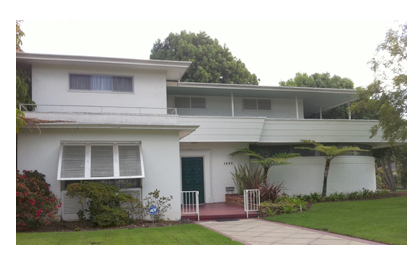
A local boy, Williams graduated from the LA. School of Art and Design, the L.A. branch of the New York Beaux-Arts Institute of Design, and USC’s School of Engineering. He married in 1917 at the First AME church and had three children. His grand-daughter Karen Hudson lives in a Williams-designed home adjacent to the original Victoria Street family home, and is a noted author and curator of her grandfather’s estate.
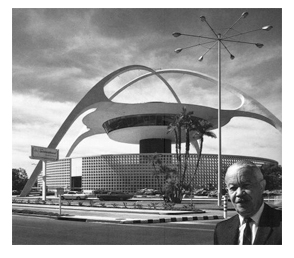 Most of Williams’ 2,000 private home designs were in Beverly Hills or the Mid-Wilshire area.
Working in a broad range of styles, he was the ‘go-to guy’ for celebrity residences for many years, Sinatra, Lucille Ball, Lon Chaney, Tyrone Power, Danny Thomas, Barbara Stanwyck, etc.
Williams’ commissions and awards are too numerous to name, the last being a post-humus Donald Trump award. Angelenos cannot drive very far without bumping into a Williams commission: the Hollywood YMCA, Saks Fifth Avenue, Beverly Hills (1940), Golden State Mutual Life (1948), Beverly Hills Hotel and Perino’s Restaurant (alterations of existing buildings), L.A. Superior Court and Hall of Administration , LAX Theme Building (1961), and the First AME Church (1963), to cite but a few. He also designed the Midtown branch of the Broadway Federal Bank at 4835 W.Venice Blvd. in Mid-City and was a Board Member.
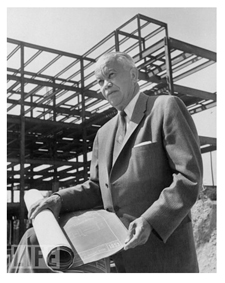
The prodigious Williams was the first African-American to be admitted to the AIA. Williams’ wife, Della Mae Williams (died 1996),co-founded the first African-American Women’s Club to have its own building in L.A, located at 3435 W. Adams.
To find out more about our amazing historic resident :
15 Brilliant United States Architects You’d Love to Know 1894 - 1913
Golden State Mutual Life Insurance Building a Historic-Cultural Monument
- Details
- Category: Architecture
- Published on Sunday, 19 June 2011 00:52
- Written by Laura Meyers
Built in 1949 and located at the intersection of Adams Boulevard and Western Avenue in the West Adams area, the five-story Golden State Mutual Life Insurance Building (GSM) is Los Angeles’s newest designated landmark.
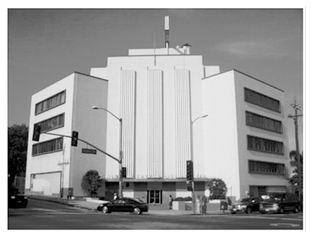
This commercial building exhibits character-defining features of the Moderne style, and was designed by architect Paul R. Williams (1894-1980). Williams was one of the foremost architects of Los Angeles in the mid-twentieth century, designing thousands of private homes as well as public and commercial buildings. Williams was also the first certified African-American architect west of the Mississippi River, the first African-American member of the American Institute of Architects, and also served on the first Los Angeles Planning Commission in 1920.
The Golden State Mutual Life Insurance Company was founded in 1925 by three African-American businessmen. Serving African-Americans who had been denied coverage by insurance companies because of racial discrimination, the company opened in a storefront in South Los Angeles and later built its own headquarters on Central Avenue (Historic-Cultural Monument #580; 1929). The company quickly grew to become the largest black-owned business west of the Mississippi River and in 1948 commissioned the construction of a new home office on Adams Boulevard. The building served as the headquarters for the company for over 60 years from 1949-2010.
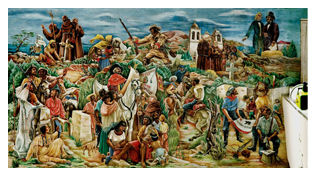 Inside, GSM’s double-height lobby features two famed murals, each 16’5” long and 9’3 1/4” tall and specifically commissioned for the building, depicting events in
Jefferson Park HPOZ Update Oct 2010
- Details
- Category: Architecture
- Published on Tuesday, 12 October 2010 16:12
- Written by John Arnold
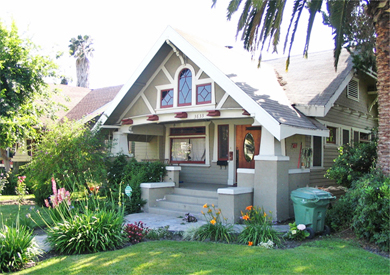
Jefferson Park is widely known to have one of the best collections of early 20th century Craftsman bungalows in the country. The district is bound by Adams, Western, Jefferson, Arlington, Exposition and 7th Avenue. Recently the proposed Jefferson Park HPOZ (Historic Preservation Overlay Zone) got a few steps closer to becoming a reality. Following a number of high-profile losses of historic structures in late 2009 and early 2010, concerned residents and preservation activists stepped up their efforts to secure an interim control ordinance (ICO) from the city. This measure would temporarily limit construction activity in the neighborhood until the implementation of the HPOZ. An ICO would be used solely to protect historic structures from changes that would diminish their historic character.
In July, with the help of Herb Wesson’s Council District 10 field office, neighbors successfully obtained city drafted HPOZ-related documents which had been lost or mothballed due to the recent fiscal crisis, allowing wealthier neighborhoods to jump ahead of Jefferson Park and become HPOZs. Armed with this public information, CD10 and HPOZ advocates got Jefferson Park onto the agenda of the City Council’s Planning and Land Use Committee meeting in August.
The Planning Department indicated that it will finally start work, after a year’s delay, on certifying the neighborhood’s professionally prepared historic resources survey, which documents the historic status of every building in the HPOZ area. To help with this effort, a team of Jefferson Park volunteers walked the streets of the neighborhood to verify the information in the survey and confirm any changes that have occurred since the survey was finished in 2009.
The HPOZ seems unlikely to be put in place for at least another year. The city contends that there are not enough funds or staff to provide administration for a new HPOZ. However, the nearby University Park HPOZ board stepped up to the plate in early September and passed a motion that states its support for the proposed Jefferson Park HPOZ and its willingness to share in the Jefferson Park administration if necessary. This idea is being floated to the Planning Department and Office of Historic Resources, which administers the HPOZ program. Neighbors are hoping that this, or some other creative solution, will get the HPOZ finalized sooner than what the city’s capabilities currently allow.
The Kurtz Residence
- Details
- Category: Architecture
- Published on Thursday, 07 October 2010 22:32
- Written by Dianne Lawrence
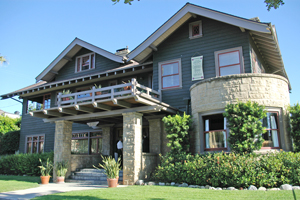
In 1908 private developer George E. Van Guysling purchased undeveloped land which he subdivided and turned into Gramercy Park. It was bordered by the gated enclave of Berkeley Square on the north and the elegant mansions of West Adams Boulevard on the south. This house, built in 1910 and currently owned by John Kurtz (whose birthday falls on the same date as the listing of the original building permit) was one of the first built by Van Guysling in Gramercy Park. The architect is listed as William F. Blaikie and the estimated original cost of the house was $6,000.
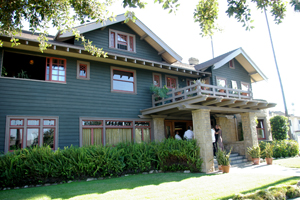
Although considered an Arts and Crafts Transitional house it bears Victorian design elements, such as a rotunda, leaded glass and window surround moldings. It also contains elements of the then modern, Arts and Crafts style, such as the stained redwood clapboard siding, post and beam constructed front porch, second-floor sleeping porches and curved dragon uplifts on the gabled roof and dormers. The horizontality of the house design, more typical of Arts and Crafts style, distinguishes it from the more vertical Victorian styles.
To see more Pictures click Read More
The Lucy E. Wheeler, Greene and Greene Residence
- Details
- Category: Architecture
- Published on Friday, 06 August 2010 11:03
- Written by Laura Meyers
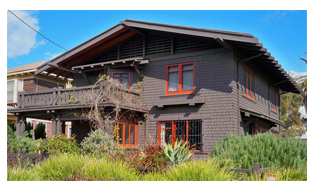
The Lucy E. Wheeler Residence, a 1905 Craftsman Bungalow home in Harvard Heights, is a significant and rare local architectural treasure designed by Charles Sumner Greene and Henry Mather Greene, masters among master architects.
The original owner, Lucy Emery Wheeler, was a pioneer in her profession as a court reporter, a leader in literary circles and an influential member of Los Angeles society. Her West Adams home was eventually converted into a three-unit residential building (after Ms. Wheeler moved out, in the 1930s) but it survived with nearly all of its original Greene and Greene features intact.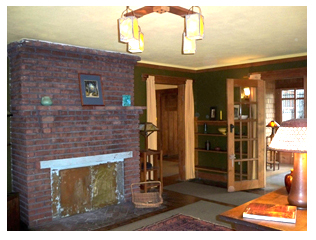
In the mid-1980s, noted restoration architect Martin Eli Weil acquired the property and began a 25-year journey of returning the structure to its original single family residence configuration. Weil passed away in 2009.
The designs of Greene and Greene houses, including the Lucy E. Wheeler Residence, express the Craftsman ethic and aesthetics: the nobility of natural materials, simple volumes, expansive use of wood, and intimacy with the landscape. Their work is often referred to as “designs for living.” Influenced by Asian/Pacific Rim designs, the Greenes used cloud-lift joints, irimoya tile roofs, and jutting rafters. On their interiors, Charles and Henry Greene created their hallmark style in their handling of the cabinetry, wood trim, stain glass windows, and self-designed lighting fixtures. In contrast to Gustav Stickley’s straight lines and plainspoken detail, the Greenes’ designs were sinuous, and featured elaborately pegged joints and intricate hand-done inlays, the mark of master craftsmen.
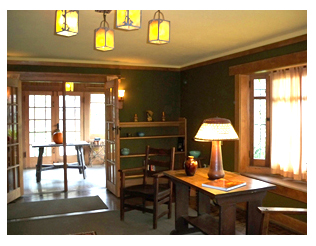 Of the approximately 200 residences and other structures designed by the Greenes scattered throughout the West Coast, fewer than half remain standing in their original location. The Greene brothers only designed a handful of homes within the city limits of Los Angeles proper and the Wheeler residence has the distinction of being the ONLY Greene and Greene-designed residence still extant in the City of Los Angeles. It is pending designation as a Los Angeles Historic Cultural Monument.
TO SEE MORE PICTURES CLICK READ MORE
The Guasti Villa
- Details
- Category: Architecture
- Published on Sunday, 06 June 2010 13:33
- Written by Renee Montgomery
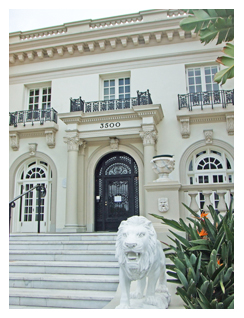 In 1910 Mr. Gausti an Italian immigrant who helped develop one of the first California vineyards into one of the world’s largest, commissioned Hudson and Munsell to design this Adams Blvd. mansion in the Beauz Arts/Italian style.
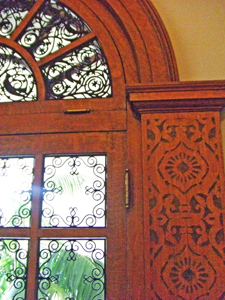
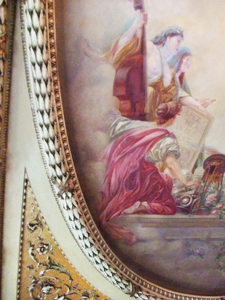
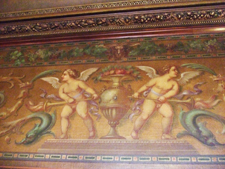
The impressive home features most of the original lighting fixtures, doors and moulding, rare bronze stair-rails, a hydrolic elevator, solarium, servants quarters, carriage house, and porte de coucher, Marble, imported from Italy came along with some artisans who were responsible for the carved wood paneling and handpainted murals adorning the ceilings, illustrated with cherubs holding grapes and other heavenly images. The bedroom of Guasti’s only surviving child reflects the boy’s muscular dystrophy in a then-state-of-the-art therapeutic shower. 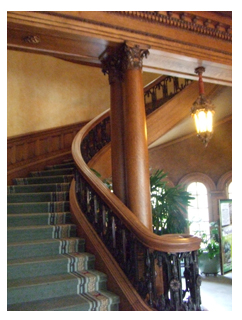 In 1937 Busby Berkely bought the home, turning the basement wine cellar into a film editing studio among other refinements.
Then in 1944 the Los Angeles Physicians Aid Association, acquired the property as a retirement home, adding two wings.
The current owners, the Movement of Spiritual and Inspirational Awareness (MSIA) purchased it in 1974 and engaged in a faithful and loving restoration after much damage caused by the 1994 earthquake.
While the home originally looked out onto rolling greens with citrus and avocado trees, it was the MSIA who developed the property into breathtaking landscaped fountains, a meditation garden and labyrinth based on the one at Chartres. Now the MSIA uses the home as the movement’s world headquarters but it mainly serves as a backdrop for special seminars, retreats, classes and visitors revolving around the beautiful grounds, labyrinth, and view.
CLICK HERE to book a tour of the home and gardens
CLICK HERE to view more pictures
3500 W Adams Blvd, Los Angeles, CA 90018
https://www.peacelabyrinth.org/villa
Jefferson Park. Preserving It's Heritage
- Details
- Category: Architecture
- Published on Wednesday, 02 June 2010 23:00
- Written by John Arnold
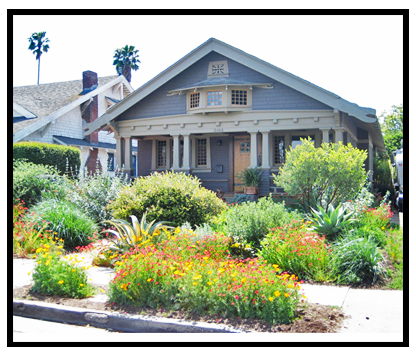 Residents of Jefferson Park have intensified their efforts over the past few weeks to gain Historic
Preservation Overlay Zone (HPOZ) protections from the City for their classic “California bungalow” architecture.
Frustrated by what they perceive to be indifference from city officials, including Council District 10 (CD10), the Planning Department, and the City Attorney, they have begun a public outreach and letter writing campaign to persuade the City to take action.
The community has been spurred on by a recent spate of permitted and unpermitted work in the neighborhood that has resulted in the irreversible damage to the historic integrity of several Craftsman bungalows.
Jefferson Park is widely known to have one of the nation’s best collections of the iconic cottages, which were widely built in Los Angeles for middle class transplants from the Midwest in the early 20th century. Since then, the modest homes have served as the bedrock housing type for Japanese, African-American, and Latino communities. Community HPOZ supporters believe that preserving the history of the neighborhood is important for community identity and memory, as well as the economic vitality of the area, from stabilizing property values to generating revenue from filming.
Community members started the HPOZ process over eight years ago, in early 2002, by gathering signatures from neighborhood residents. 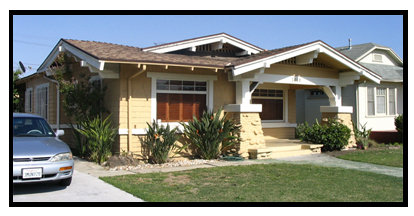
This grassroots movement led then-councilmember Nate Holden to introduce a motion to the LA City Council to direct the planning department to gather the necessary data to make a Jefferson Park HPOZ a reality. Over the years, the process has stopped and started depending on available city financing and staff availability. Finally, by summer of 2009, the City was able to finance and finish, with significant community help, the collection of historical data that would become the basis of a historic designation. Unfortunately, due to the recent severe budget crisis and turmoil at City Hall, that document, and the promise that it holds to preserve architecture and enhance public awareness and education of the district’s historic resources, has been sitting on a shelf at the City with no action taken.
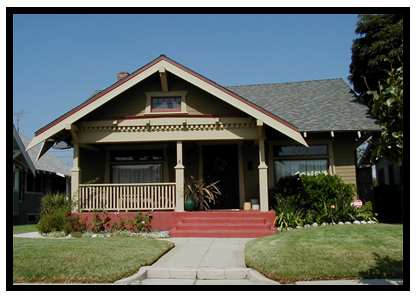
Neighborhood residents are seeking to change that. They have been pushing the Council Office, the Planning Department, and the City Attorney to take action, as well as offering efficient, inexpensive, and creative solutions to help the cash-strapped city with the HPOZ’s implementation. Ideas include temporarily linking the new Jefferson Park HPOZ to an existing HPOZ close by until times are better, and hiring consultants with existing neighborhood funds to help city staff with administration.
Council District 10 staff have been responsive to recent requests for action. With this support, neighborhood leaders are hopeful to have at least some official historic district recognition and protections, if not full HPOZ status, by this summer.
TO SEE MORE PICS CLICK READ MORE
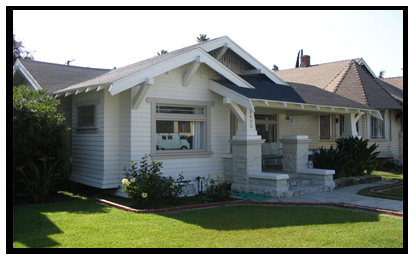
"This Old House" magazine sites West Adams as Cal. Best Place to buy an old house.
- Details
- Category: Architecture
- Published on Wednesday, 12 May 2010 11:53
- Written by Michelle Hofmann LA TIMES
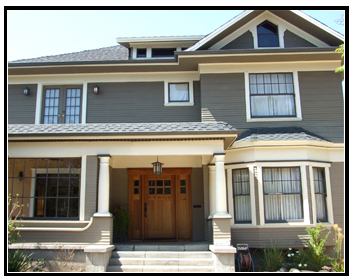 In their third annual search for the best places to buy an old house, "This Old House" magazine editors selected one neighborhood from every state "populated by people who share an appreciation of finely
crafted homes that have plenty of past and lots of future."
In California, the West Adams area of Los Angeles made the cut. One of L.A.’s oldest neighborhoods, West Adams borders Figueroa Street on the east, West Boulevard on the west, Pico Boulevard on the north and Jefferson Boulevard on the south. It was developed mostly from the 1880s to the 1920s as ahaven for entrepreneurial elites and oil barons and later attracted Hollywood stars and musical legends.
"It’s a hidden gem," said resident and interior designer John Patterson, a board member with the West Adams Heritage Assn.
"West Adams is like another world and full of turn-of-century homes that have been lovingly restored,"
said Patterson, who purchased a home in 2004 and renovated the property.
The West Adams District has seven historic preservation overlay zones (HPOZs): University Park,
Adams-Normandie, Harvard Heights, Pico Union, Western Heights, West Adams Terrace and
Lafayette Square. The area has one historic preservation specific plan (North University Park).
Jefferson Park and Country Club Park reportedly also are pending HPOZ designations that are stalled
because of the city budget crisis.
HPOZs are designated as uniquely historic communities and buying in one is a smart investment, according to Keith Pandolfi, associate editor of "This Old House."
"The fact that the neighborhood is in a historic overlay zone helps protect the facades of these houses. That means property values will probably keep rising," Pandolfi said.
Pandolfi says the area is the kind of place where you can find a solid old house that looks and feels like an authentic old-fashioned American neighborhood and features some of the most whimsical takes on Craftsman architecture he’s ever seen.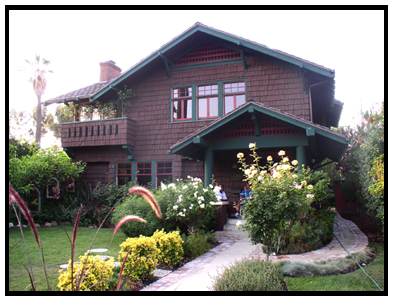
"I think that when outsiders think of L.A. houses, the first thing that pops into their heads is some meandering modern mansion somewhere in the Hollywood Hills. That’s why we wanted to call attention to West Adams," Pandolfi noted.
"Housing values here were climbing fast before the recession hit, but you can still find a relatively
affordable house there. We like the fact that so many residents are moving there to restore older
homes too," he added.
Before you buy a historic home, preservation experts say consider the emotional and financial costs of
ongoing maintenance projects. Recognize that the property must have an historic designation in order
to obtain the few financial preservation incentives available in L.A. Know that the historic designation
alone will not suffice for the city of L.A.'s Mills Act historical property tax deduction program. And
realize you are buying a neighborhood, not just a house.
Because many of the best historic homes never officially hit the market, David Raposa, broker-owner of L.A.-based City Living Realty, who has specialized in historic neighborhoods for 26 years, says do your homework. "Some houses may be quietly available for sale. So get to know the insiders, whether it’s a local real estate agent or the neighborhood preservationists and community advocates," he said.
Always wanted your own painted lady? Here’s a quick look at what’s on the market in the area.
1617 S. Norton Ave., L.A.
Listed at a reduced price of $429,000 on Redfin.com, this three-bedroom, 1 1/2-bathroom singlefamily
West Adams bungalow in Arlington Heights originally listed for $455,000 and was built in
1915. It has about 1,896 square feet, features a hot tub in the master bedroom and includes approved
plans from the city to build a duplex.
928 20th St., L.A.
Listed at $779,000 on Trulia.com, this four-bedroom, three-bathroom Craftsman home in the
University Park area was built in 1910 and has 2,772 square feet and a large yard with fruit trees.
Listing agent Anna Solomon of Prudential California Realty in Brentwood says the home reminds herof a Queen Anne Victorian. "The woods in the house are spectacular, and everything is built in. It is just beautiful," she said. "It’s a great house with huge rooms and an oversized garage."
2175 Cambridge St., L.A.
Set to go on the market in a few weeks at $775,000, this quintessential Arts and Crafts-style home is reported to be the only home remaining in L.A. city proper designed by brothers Charles and Henry Greene, the architects responsible for Pasadena’s famed Gamble House, according to listing agent David Raposa, broker-owner of L.A.-based City Living Realty. Located in the Harvard Heights HPOZ, the home was built in 1905 with three bedrooms and 2 1/2 bathrooms in about 2,600 square feet and features a sun room, a den and partial restoration.
2251 Cambridge St., L.A.
Listed at $485,000 on Trulia, this spacious four-bedroom, one-bathroom Craftsman home in the
Harvard Heights HPOZ was built in 1912 and has 2,420 square feet.
2903 S. Victoria Ave., L.A.
Although not in a historic zone, this single-family West Adams Craftsman is listed at $570,000 on
Redfin.com and has three-bedrooms and 1 1/2-bathrooms in 1,530 square feet. The 1927 home has a detached garage and a breakfast nook. {jcomments off}
--
The Helen & Fredrick Booker Residence
- Details
- Category: Architecture
- Published on Thursday, 08 April 2010 19:45
- Written by Renee Montgomery
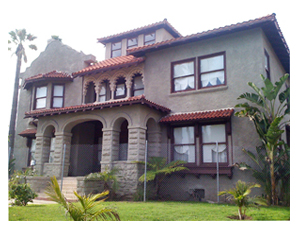 Sugar Hill Date: 1903
Style: Mission Revival Mediterranean
Architect: A.M. Edelman
The work of designer James Cuzner, a partner in the Cuzner-Kerkhoff lumber firm, is manifest in this spectacular home’s detailed woodwork in oak, Douglas fir and redwood. Edelman was a prominent architect at the turn of the century, designing many homes along Figueroa and Flower. At more than 8,000 square feet, this huge home includes six bedrooms, six baths, parlor, spacious foyer, library, formal dining room, full kitchen with butler’s pantry, dormer room, basement, walk-in safe, commodious porches, original fireplaces, doors, windows and other fixtures. Exterior detail consists of a second floor arcade with Moorish arches, parapets, quatrefoil windows. One of only a few homes remaining in this style it sits majestically on a corner lot in Sugar Hill. Most impressive though is how the Booker’s have virtually brought this house ‘back from the dead’ since purchasing it after a 1998 fire, reconstructing the roof structure and repairing original wood moulding and flooring throughout. Eating graciously every evening in the formal dining room despite being surrounded by ongoing work all during ten years of renovation, the Booker’s represent the tencious spirit that is restoring West Adams to its former glory.
More Articles...
- The Doors of West Adams
- Judy and Wilbur Hawkins Residence
- Miller Calhoun Residence
- Kim and Jennifer Watson Residence
- The Chen/Gruenberg Residence
- Chen/Gruenberg Residence
- The Susan and Antonio Vargas Residence
- Kwesi and Jennifer, Alex and Auzzie Ankai Residence
- The Michael and Karen Schultz Residence
- The Judy and Wilbert Hawkins Residence
Yesterday15
Week60
Month253
All990355
Currently are 24 guests and no members online
Kubik-Rubik Joomla! Extensions