

IF ONLY WALLS COULD SPEAK!


- Details
- Category: Architecture
- Published on Thursday, 23 June 2016 15:40
- Written by MITZI MARCH-MOGUL
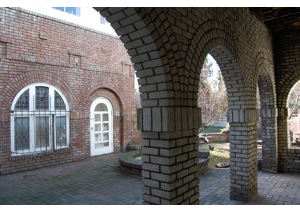 People often think of history as an impersonal collection of facts and dates, a dusty inventory of data without relevance to modern life. But the past can get quite personal when looked at as the stories of people like us and how their actions and feelings influenced, and sometimes left a lasting impact on their communities and society.In the West Adams District, these stories are right under our noses, if we only take the time to look. History is not a dry recitation of facts; it’s the story of people and what they did and how and why they did it. But if you don’t have a name, how do you find the story? Houses (and other types of structures) provide the names through building and municipal records, architectural archives, historical publications, and other documents. The older homes are a gateway to a rich and entertaining narrative—drama and comedy, tragedy and romance, beautiful and terrible. In a way, because we live in these homes, we become a continuation of the story.
As a Historic Preservation Consultant, a lot of my time is spent researching people who lived long ago. Some stories are more interesting than others, but as a whole, it is fascinating to learn what life was like fifty or one hundred years ago; in some ways it has changed very little, and in other ways how improved it has become!
Many people who made lasting contributions are still known today as they live on in the names of streets where they had interests. Crenshaw, Pico, Dalton, Rimpau, Degnan, Leimert and Hoover (to name a few) all had an impact on how Los Angeles developed and they lived right here in West Adams.
Others lived in obscurity until research uncovered their story. A home in Harvard Heights became the center of a zoning issue which required researching the history of the property. It turned out that the house had been designed by a master architect for a downtown businessman and later became the Mormon Mission. Beginning in 1929, for two decades the house served as the central location for LDS Church activities and some of the most important leaders of the church lived there or conducted business and religious meetings there. Few people realize that the Mormons made significant contributions to the development of Los Angeles and Southern California, including founding San Bernardino. We are so fortunate that the house was still there, largely unchanged, so that we could uncover the important story that it represented. It is now a Los Angeles Historic-Cultural Monument.
Another home in West Adams represents 135 years of Los Angeles history. Built circa 1876, it is one of the oldest identified still-standing Victorian-era wood-framed homes, a rarity indeed. Although it had been in the same family since the 1930s, it wasn’t until a few years ago that its full history emerged. In 1875, Thomas Bruen Brown had just earned his law degree in Washington, D.C., arriving in Los Angeles, where he became District Attorney. He purchased the property, planted his acres in oranges, and hired the most prominent architect of the day to build a fine Italianate-style home for his soon-to-be bride. He
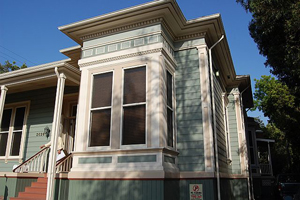 married Eleanor Thornton Patton, daughter of Susan Glassell Patton, widow of Confederate Colonel George Patton, and whose brother was Andrew Glassell, founder of Glassell Park. Eleanor would later be the aunt of General George S. Patton, Jr. Her sister would later marry Hancock Banning. These “first families of Los Angeles” would remain entwined for many years, shaping the future of Los Angeles. By the time the Gorsline family purchased the house in 1934 the neighborhood had changed significantly. Gone were the orange groves and vineyards, but the house remained, again largely unchanged, waiting to reveal its glorious past and its connection to these interesting and important people.
Do you live in an older home? Do you know when it was built or who built it? Have you ever thought about what it was like when it was new? What the neighborhood like? If you had lived there in those early years, what would daily life have been like? Men would have been wearing shirts with high stiff collars and hat—straw for the summer, wool felt during the winter. Women would be wearing many layers of undergarments, long dresses and high button shoes. Relief came in the 1920’s when clothing (at least for women) became loose and short. What story lies buried by time, waiting for an opportunity to pull back the curtain of time? If you purchased your house fairly recently, you might be eligible for the Mills Act Property Tax Rebate Program, but to qualify you must be either a Historic Cultural Monument (HCM) or a Contributor in a Historic Preservation Overlay Zone. Becoming an HCM starts with a story—yours.
There are so many homes with fascinating, glamorous, startling stories, too many to tell in this space. And there are thousands more still waiting to be discovered. I sometimes joke that I am catching up on my newspaper reading—I’m only about 100 years behind!
Restoring An Architectural Treasure
- Details
- Category: Architecture
- Published on Monday, 12 October 2015 13:58
- Written by Renee Montgomery
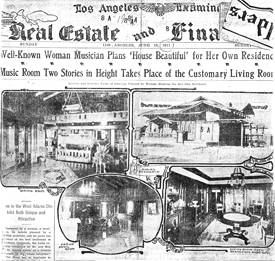 In 1911, upon the completion of the magnificent home at 2508 9th Avenue, the Los Angeles Herald Examiner referred to it as "House beautiful . . . no duplicate in Southern California". Custom designed in an impressive “high” Arts-and-Crafts style by the renowned Heineman architectural firm for Mr. and Mrs. R.H. Adams, the house is now being readied for sale by the current owner.
 Since purchasing the private residence eleven years ago, the owner has aimed to bring the 3,326-square-foot edifice back to its original glory. The remaining significant restoration work will be left to a new owner, per David Raposa of City Living Realty, a firm that specializes in vintage, landmark and architectural properties in West Adams. Having restored his own Heineman home as well as several other local historic properties, Raposa has been advising the owner on the restoration. (View our report on his award-winning restoration of the Joseph Lee Starr dairy house on our website).
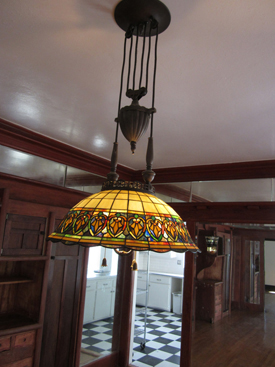 In fact, Raposa had been watching this special house for nearly three decades, and when a prior owner began some unfortunate renovations 20 years ago, Raposa rescued and stored the Adams’ original main-room signature mantle which will now rejoin the rebuilt fireplace.
The Heineman firm, consisting of Arthur, Alfred and Herbert Heineman, was a major force in the Southern California Arts and Crafts movement -- probably the most famous family architectural name after Greene & Greene. Per Raposa, there are at least five remaining large-scale Heineman homes in the West Adams District. Several in Pasadena have been the subject of their own Heineman tour.
Careful archival research has always been an important part of Raposa's methodology. He recommends two must-check sources for all historic home buyers: the newspaper(s) of the time, such as the Herald Examiner, and the publication Southwest Building and Contractor for the name of the architect, builder and/or contractor. An increasing number of publications have been digitized, facilitating research. Raposa has often consulted the L.A. Library system, and in the case of the Adams’ home, Raposa was fortunate that some Heineman archives had been donated to the Huntington Library.
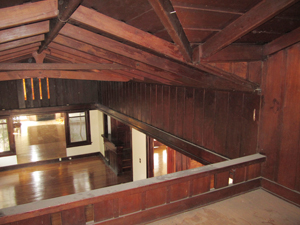 That is where he found the 1911 Los Angeles Examiner article which detailed that the two-story music room in the Adams house had been designed with perfect acoustics for Mrs. Adams, a professional musician. This explains why the music room -- still with its original trussed ceiling with exposed wood beams and glorious wood paneling -- serves as the home’s main focus. Spanning the music room is an impressive mezzanine balcony accessible via a winding staircase from the den. The original furniture and lighting have been stripped but fortunately the 1911 newspaper’s interior photos depict those items, including several wall tapestries.
 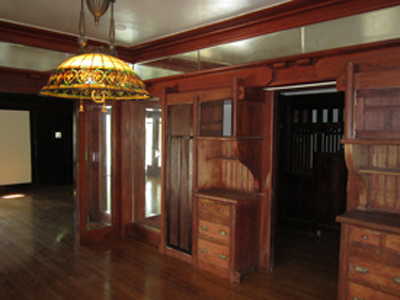 While the 1911 kitchen has been removed from the Adams home, the Examiner article also shows that the breakfast room originally opened up into a magnificent side yard with a multi-room pergola with Japanese garden.
Another important resource in tracking ownership and certain details, per Raposa, is the County Tax Assessor’s office in Culver City. Simply provide evidence that you are indeed the current owner, and ask for a senior staff person, since he/she may have a deeper knowledge and willingness to consult their historic records. Another valuable source: early Sanborn maps, produced for insurance purposes, show footprints and details of buildings and are helpful in tracking any additions or alterations.
The music room's art glass windows in the Adams home happen to still be intact, as well as the hardware, but Raposa suggests as a good resource Liz’s Antique Hardware on La Brea, and also EBay. One should also contact the West Adams Heritage Association for helpful information, and Raposa reports that HPOZ boards can also be very knowledgeable about possible sources. Some restorers are beginning to experiment with 3-D printers to replicate historic details.
There are some incentive programs for owners wishing to properly restore a historic home. The most popular is the Mills Act Historical Property Contracts program, which offers property tax reductions. To qualify for the Mills Act, the property must have city landmark status or be a contributor to an HPOZ, and the owner must have lots of patience since the program is only offered once a year.
Homeowners should assume there are no grants for historic restoration, Raposa warns.
What Is An HPOZ?
- Details
- Category: Architecture
- Published on Wednesday, 22 April 2015 15:59
- Written by Jefferson Park/Laura Meyers
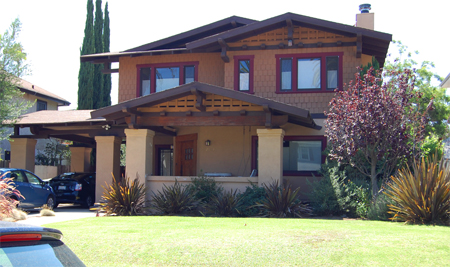
Historic districts in Los Angeles are defined by a special zoning ordinance called the Historic Preservation Overlay Zone (HPOZ), which is a City Planning Department designation added to our existing zoning regulations.
WHAT DOES AN HPOZ DO?
HPOZ designation recognizes the special importance of of a neighborhood, helping increase community pride and helping the neighborhood gain more importance and distinction in the eyes of many City employees.
The HPOZ historic designation applies only to the exteriors of buildings, and the site surrounding them. This includes features such as windows, doors, roofs, and porches, along with landscape and hardscape features such as driveways and walkways. HPOZ designation does not apply to any building interior and does not affect interior alterations.
HPOZ designation does NOT require that anyone spend money to restore a building or to make any alterations or improvements.
HPOZ designation can lower property taxes. Qualifying houses in HPOZs can apply to a state program (the Mills Act) which can reduce property taxes by up to 50%. HPOZ designation will NOT result in higher taxes.
HPOZ designation can increase the value of property. Studies have shown that over the long term historic districts have higher property values.
HPOZ designation can save homeowners money. Exterior alterations are reviewed by a neighborhood board experienced with fixing up and maintaining historic buildings. They can advise you on how to do the work, how to save money, and where to find resources for improvement.
HPOZ designation gives neighbors a greater say over new development, such as apartment or commercial buildings along the main boulevards.
HOW DOES AN HPOZ WORK?
Each HPOZ establishes a neighborhood design review board which is an advisory body to the City Planning Department. Each board consists neighbors and professionals who are knowledgeable about the history and architecture of the community, historic preservation requirements and, ideally, restoration construction techniques. The board members are appointed by various City entities.
The HPOZ is part of the normal building permit process. If a homeowner decides to start a project that requires a building permit, such as a new addition, or new windows, then the Planning Department and for many items the HPOZ board reviews and approves the project.
Each HPOZ has a Preservation Plan that includes guidelines that are commonly used by historic districts throughout the country.
HPOZs have different procedures depending on the type of work that is being proposed. In general, work that does not require a permit, such as routine maintenance, is not reviewed by the board. Regular work that needs a permit is reviewed by the board which makes a recommendation to the Planning Department. Minor changes to the exterior are handled by the board quickly. Major work, such as demolition, removal of the exterior of a historic building, or the construction of new buildings, requires a public hearing. All decisions can be appealed to the Planning Commission.
If you do live in or own property within an HPOZ, there are additional benefits (for example, you can utilize the State Historic Building Code when renovating your house, bypassing some local building codes that do not reflect the realities of older construction. And, you may not need to retrofit older toilets to comply with water conservation regulations upon sale of your house.) But you should also be sure to get building permits for any construction work you do, since neighbors in HPOZs do tend to keep an eagle eye out for unpermitted construction.
It's been said that the owner of a historic house is only its steward for a short period of time, but its architecture can inform many future generations about the history of not just the building but also the people who together created the communities we call home. HPOZs help ensure those legacies.
Re-Inhabit Inhabits West Adams
- Details
- Category: Architecture
- Published on Friday, 15 August 2014 16:49
- Written by Renee Montgomery
Previously focusing on the communities of Atwater Village, Silver Lake, Los Feliz, Hollywood Hills, Glassell Park, Highland Park and Echo Park, Re-Inhabit recently discovered the beauties of West Adams while developing a residential property at 1700 S. Harvard in Sugar Hill. Work crews started in February 2014 and before the renovations were completed, the single-family dwelling sold by early May.
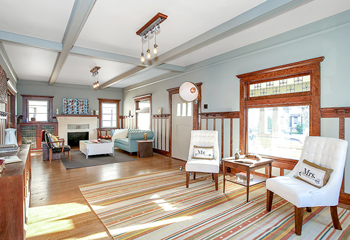
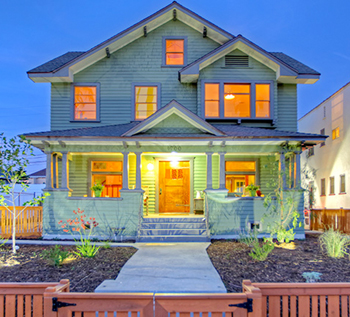 Features of this two story Craftsman house located between Venice and Washington Boulevards., include a gabled roof, clapboard siding, and four pairs of noble columns supporting the overhang of a full-length porch. Work included removing awnings, knocking down un-original walls and tearing up rotted flooring, all per Harvard Heights HPOZ standards. As Re-Inhabit founder and President Rudy Dvorak describes, “We’re careful to preserve a home’s character . . . and deliberate about the materials we choose.” The Harvard exterior was painstakingly scraped, sanded and scrubbed of its 1970s textured paint coating inch-by-inch. However the firm is realistic about the modern day expectations of buyers. “We’re decisive about what needs to be done to increase the value and function of a property.” One and ½ baths were added and the kitchen was upgraded to contemporary standards while leaving charming original details, like the original wood cabinetry.
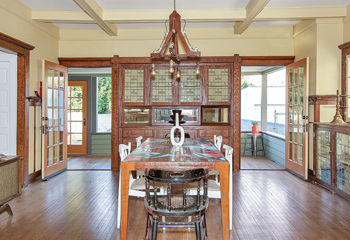 Re-Inhabit integrates green standards into their projects, and uses reclaimed materials.
 What is most exciting is the attention this chic firm brings to the area. As their stylish promotional materials announce “. . . if you abandon your normal route, get off the freeways and cruise the surface streets you’ll discover neighborhoods throughout LA that are absolute gems. These areas are rich in history, filled with beautiful homes, and have managed to sneak under the radar of yet another frenzied real estate market. . . .One such area to which Re-Inhabit has turned its attention is Harvard Heights whose streets are lined with fabulous Craftsman homes built in the first decade of the 1900’s.” Something that Mid-City residents have known for a long time, but real estate investors have largely ignored.
Re-Inhabit looks at overall potential of a property rather than specializing on a certain price range. Dvorak points out though that developers are hard pressed to realize sizeable gains in historic neighborhoods however, because of the high cost of careful restoration. A native of Laguna Beach currently living in Orange County, Dvorak developed a love for historic homes and West Adams when attending USC. The developers who have a sister interior design firm called L.A. Salvage. organized an art show in lieu of a real estate open house. Re-Inhabit and LA Salvage’s stunning design sense is evident in every detail of the home.
 In fact Dvorak is so high on West Adams, he’s closing on another property on Hobart Boulevard near Washington Boulevard, which he will soon call home for himself, wife, three tweener/teens and beagle mix named “Nike.” While there were many surprising challenges with the first Harvard Street house, Dvorak’s best news was how gracious and welcoming the neighbors were.
 TNN says "Welcome to our community!"
David Raposa Wins 2014 Los Angeles Conservancy Preservation Award for Starr Dairy Farmhouse In Jefferson Park
- Details
- Category: Architecture
- Published on Friday, 08 August 2014 16:47
- Written by Cindy Olnick
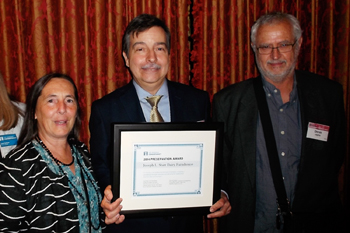
Laura Meyers served as the historic consultant for the project, and Derek Japha was the architectural designer. Restoration architect Martin Eli Weil had also consulted on the project before his death in February 2009. Carpenters Taidgh O’Neill and Bob Gangl, among other talented craftsmen, rebuilt the Victorian era farmhouse, which is the oldest house in Jefferson Park and the last remnant of the neighborhood’s agricultural history.
The Joseph Lee Starr Dairy Farmhouse was built in 1887 for a dairy operation started by Texas cattleman J. L. Starr. At that time, the dairy spanned twenty acres on what was then the western edge of Los Angeles. The farmhouse was designed in the Folk Vernacular Victorian style by fellow ex-Texan Jasper Newton Preston. The well-known architect had moved to Los Angeles to complete commissions for the County Hall of Records (1887), the Andrew Glassell residence (1887), and Los Angeles High School (1890). He is also known for many works in Texas, such as the Driskill Hotel in Austin (1886).
By 2008, after decades of neglect, the house stood vacant, had been partially demolished, and was rapidly deteriorating. The City of Los Angeles deemed the home a public nuisance, and it was in danger of being razed. During its vacancy, the building was occupied by drug users and vagrants. Then a subsequent owner
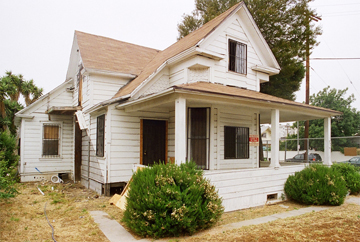 demolished not only a garage and out-building, but also the farmhouse’s early service porch addition and many interior elements. It had decayed rapidly to the extent that the public questioned whether the site
  could, but more importantly, should, even be saved.
 According to the Conservancy’s description of why he won an award, Raposa “rescued it from the brink of demolition, painstakingly restoring it in an effort that redefines determination. He even used the project to educate the community, providing public access then and now to promote the value of preservation.”
Striving for the greatest possible historical accuracy, the project team conducted extensive research, from pulling records from the nineteenth century to peeling back the layers of the house to determine its original structure and colors.
An informational banner and website informed neighbors of the project and helped foster support for a historic district (Historic Preservation Overlay Zone, or HPOZ).
“The restored J. L. Starr Dairy Farmhouse provides enthusiasm and encouragement for future historic preservation projects in the local community, and was also open for public tours and training for HPOZ staff,” according to the Conservancy. “It is a shining example for others who dream of saving neglected landmarks.”
The awards are selected by an independent jury of leading experts in architecture, historic preservation, and community development. This was another competitive year, with 26 nominations submitted and many deserving projects. Among other award recipients are the Ace Hotel and Ace Hotel Theatre in Downtown; the reinvented Forum in Inglewood; the Dunbar Hotel on Central Avenue; Rancho Los Alamitos’ Barns Area and Rancho Center; and Bob Hope Patriotic Hall, along with a special award for the Wilshire Boulevard Temple.
The Conservancy presented the awards at its sold-out Annual Preservation Awards Luncheon at the Millennium Biltmore Hotel in Los Angeles on July 31. The luncheon is a rare opportunity for hundreds of business and community leaders to hear inspirational stories of how historic preservation strengthens communities and fosters economic development. City National Bank served as presenting sponsor of the luncheon for the fourteenth consecutive year.
To View more pictures of the house go to:
www.starrfarmhouse.com
Landmark Bekins Building Facade Threatened
- Details
- Category: Architecture
- Published on Friday, 27 December 2013 16:29
- Written by West Adams Heritage Newsletter
The historical integrity of the landmark Bekins Building, which sits on the corner of Pico and Crenshaw, is currently being threatened by proposed changes to its iconic Art Deco façade.
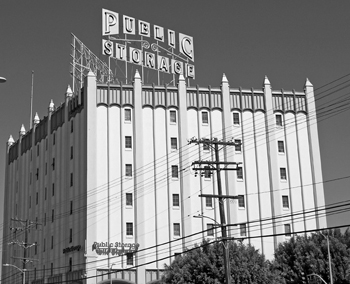 West Adams neighbors attended a hearing regarding the 12 4-G cellular antennas that AT&T wants to install on the former Bekins Building (now Public Storage).
AT&T insists that placing the antennas on the decorative design edging the top of the building will have no significant effect on the character of the structure. This was disputed by West Adams Heritage Association (WAHA) and also by the local neighborhood council, United Neighborhoods of the Historic Arlington Heights, West Adams and Jefferson Park Communities and UNNC a Neighborhood Council.
In 2011 the building had already been determined to be an historic resource when Public Storage purchased the building and proposed a rehabilitation and new signage. At that time, the company’s own historic consultant determined that this particular Bekins Building was the original model building for other Art Deco era/style storage buildings that Bekins went on to erect, and thus it was more important than a simple study of period architecture.
About a year later, Public Storage was required to go through a second environmental process when it proposed changing the words of the iconic rooftop signs from “BEKINS” Storage to “PUBLIC” Storage.
Despite this, AT&T started a new conversation by stating the building was not historic, and it was “categorically exempt” from a CEQA (California Environmental Quality Act) review. When a project is exempt from CEQA review, the City cannot require changes to protect the historic character of a building. WAHA argued against the exemption by pointing out that, although it is true that it is not a designated Los Angeles Historic Cultural Monument, it is not correct that it is not deemed historic. It is on the former Community Redevelopment Agency’s historic resource list (thus deemed historic for land use entitlements), SurveyLA has identified it as Individually Eligible for the National Register of Historic Places, and its owner’s consultant basically determined it to be a historic resource.

AT&T also said it was relying on a letter that had been issued by the State Historic Preservation Office (SHPO), which stated that the project did not have an impact on a historic resource. AT&T asserted that it meant their project met preservation guidelines, but it turned out that SHPO had not realized the building was on a list of historic resources; once the state officials realized that SHPO reversed its earlier determination and rescinded the letter.
Before the hearing, historic consultant and Art Deco expert Mitzi March Mogul reviewed the proposed project/wireless 4G installation in detail, as did the affected neighborhood council, UNNC. In addition, neighbors reviewed the older case files for AT&T’s original underlying Zoning Administrator approval, issued in 1996, which granted AT&T the right to have cell antennas. The approval stated that: “The facades of the existing building will not be altered. The surrounding area is generally developed with structures with lower overall heights. The visibility from these properties and from the street will be minimal.”
At the hearing, attended by WAHA members Mogul, Jean Frost, and Jim Childs along with Laura Meyers and Norman Gilmore on behalf of UNNC, Associate Zoning Administrator Jim Tokunaga left the matter open until he heard from both SHPO (with an updated assessment) and the City Planning Department’s Office of Historic Resources (OHR). Lambert Geissinger at OHR, who acts on behalf of the City’s Cultural Heritage Commission, has already stated in an email that the AT&T proposal did not meet the Secretary of Interior Standards (and therefore cannot be categorically exempt from CEQA.) He prefers a facility that would be installed on the rooftop.
A final decision date was unknown at press time.
A Dairy Farm in Jefferson Park
- Details
- Category: Architecture
- Published on Tuesday, 30 April 2013 15:40
- Written by Renee Montgomery
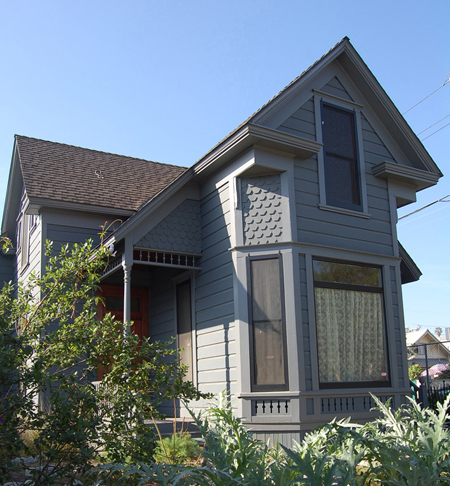
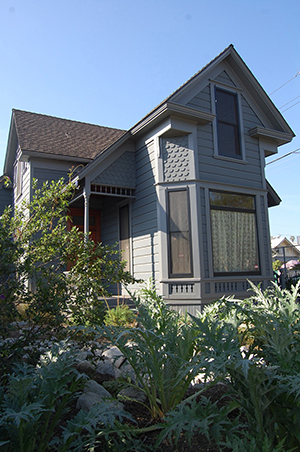 Dairy farmhouse and Jefferson Park – not two phrases often heard together. However, tucked away in the crowded neighborhood along Arlington south of Adams Boulevard is a remnant of L.A.’s agricultural past - the Starr Farmhouse, a Victorian cottage built from 1887 to 1888. Currently owned by historic preservationist/real estate broker David Raposa, the small house at 2801 S. Arlington Avenue originally served as residence and office to the Starr family’s dairy, stretching out twenty acres to the southwest.
 Joseph Starr, who had decided to establish a dairy in Southern California following the success of a similar venture in Ventura, built the Farmhouse in 1887 just outside the L.A. city boundaries - intending to capitalize on the burgeoning Angeleno population of the late 19th century. The “Starr/Estrella” dairy was entirely relocated by 1907 to make way for residential tracts and with all the property gradually selling off since that time, the Farmhouse now sits on a small city lot surrounded by early-20th-century bungalows. However, TNN readers can now witness the exceptional, original farmhouse due to its loving restoration by Raposa with the help of local architectural historian Laura Meyers.
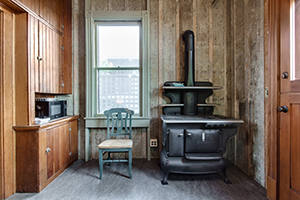 Investing enormous resources and expertise since 2008, Raposa and Meyers have converted a neighborhood eyesore into a gleaming historical treasure. “What a wreck” is how Raposa described the property as he acquired it. In 2005, the Farmhouse property was nuisance abated by the city and was then auctioned at Probate Court as a part of a conservatorship of an elderly incapacitated owner. It was filled waist-high with debris.
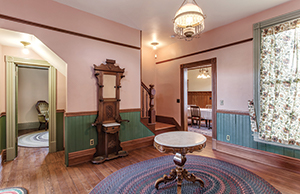 The two described the complicated detective and decision-making process of trying to restore the integrity of the farmhouse, which had been modified by Starr over time and had undergone several successive changes through different owners including being split into a duplex. They had to combine the need to discreetly upgrade the site for modern living with central air and heat, kitchen, and bath amenities with historic preservation guidelines. These issues of historic home restoration were further compounded by the permitting process; the property had already been granted landmark status (L.A. Historical Cultural Monument No. 865) so every step was closely regulated by the federal Secretary of Interior Rehabilitation Standards and California Historical Building Codes. “Peeling back layers” is how Raposa described the long process.
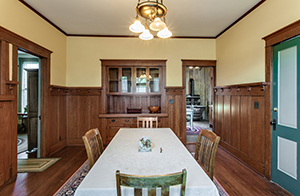 The house had been designed from 1887 to 1888 by prominent architect Joseph Newton Preston, also responsible for the original L.A. High School and County Courthouse. Raposa and Meyers surmise Preston agreed to do the modest farmhouse as a favor since both men were originally from Austin, Texas. The Victorian cottage would have housed Starr’s wife and seven young children but also shows signs of its original dual-purpose as a working farmhouse. A separate exterior door to a front parlor probably indicates this room was used as a business office.
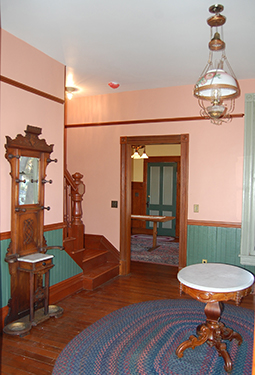 At one point, the house was expanded by the Starrs by simply pulling up a ranch “outbuilding” against the original house footprint, per 1890 tax records. The single-thickness construction of the walls and stall-like imprints in the paint surface may indicate this add-on had served as a stable previously. Such organic architectural developments are typical of farm constructions where sheds and other outbuildings are often enclosed or upgraded over time to become more formal dwellings. For example, what would have been a barn and later the ranch hands’ bunkhouse still exists on the property immediately behind the Starr Farmhouse.
Despite extensive research, Raposa and Meyers, unable to find any Starr family heirs, could not uncover much written or photographic documentation of the original house or farm. One exception is a former dairy employee's granddaughter, who came to visit one day to recount her grandfather's experience working for the dairy.
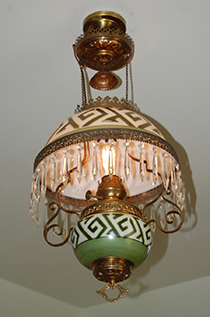 The Raposa/Meyer restoration includes many exacting features. A later 1920s wrap-around porch was restored to the original 1887 porch. Period paint colors were investigated. Molding and doors were custom-milled to match original detail – using Paramount Studios’ set carpenters on occasion. Original kerosene lamps were retrofitted for electricity and door/window hardware matched. A 1912 stove from the factory where Raposa’s grandfather worked was also integrated.
After the restoration was completed, Raposa and Meyers won two prestigious preservation awards – one from the Los Angeles Conservancy and the other from the City of Los Angeles Office of Historic Resources.
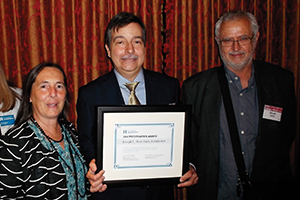
Laura Myers, David Raposa, Derek Japha
Kite Coffee Shop (Vintage Hollywood)
- Details
- Category: Architecture
- Published on Friday, 12 October 2012 13:41
- Written by Mitzi March Mogul
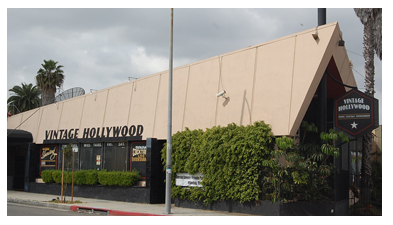 The little building at the southwest corner of Washington Boulevard and 10th Avenue with the odd-shaped roofline is a place that is familiar to all, yet completely unknown.
Its current name is Vintage Hollywood. But long before it was a nightclub showcase, it was a coffee shop which served the community. This sweet little building was recently nominated as a Historic Cultural Monument. The application was taken under consideration by the Cultural Heritage Commission who will make a final decision on Thursday, October 4th.
The coffee shop was built in 1964, the same time as the rest of the Washington Square shopping center. Originally called Stan’s Kite Restaurant, it continued to serve the community under a variety of names: Safari, EAT, a comedy club called Mixed Nuts, and finally, Vintage Hollywood. The restaurant is an excellent example of the “Googie” type of architecture which was pioneered here in Southern California and became an important architectural reference. It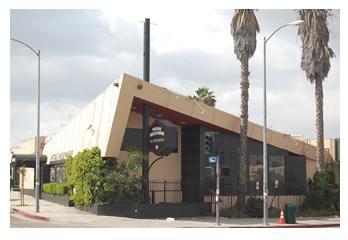 is a rare example in this community and represents the relationship between the style and the neighborhoods in the same way that neighborhood movie theaters were important expressions of theater design, different from the larger, more “showy” first-run theaters. Both play an important role in fleshing out the story of architectural, social, and economic development.
Both the shopping center and the coffee shop were designed by the noted architectural firm of Stiles and Robert Clements. The name Stiles O. Clements is well known through the important Art Deco buildings he designed, such landmarks as the Wiltern and Mayan Theaters, Samson-Uniroyal Tire Factory, and many others. His son Robert also became an architect, graduating from USC in 1941, serving in the Marine Corps during World War II, and finally returning to Los Angeles where, in 1945, he became first a partner with his famous father and then the firm’s primary designer as his father aged, retired, and then passed away in January 1966.
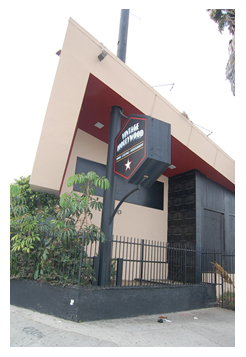 Robert O. Clements took the firm in a new direction, utilizing modern materials and forms that reflected a mid-century sensibility and this city’s reinvention of itself. This was the only coffee shop design by that firm, making it a unique representation of their architectural oeuvre.
The building has all the hallmarks of the classic Googie style: a distinct angular roof line detailed with lines of neon, plate glass windows, and signage which makes it visually identifiable to motorists. Decorative ceramic tile inside and out is an unusual component, not typically seen on buildings of this style. The interior was expanded many years ago to incorporate a small retail space, formerly the office of boxing champ Sugar Ray Robinson.
The aftermath of the Watt’s Riots in 1965, left an atmosphere of fear and mistrust with regard to the area, leading to abandonment of wide swaths of communities. Many types of businesses were unable to obtain insurance due to “redlining” schemes. Others were unable to obtain small business loans or other standard types of financial assistance. It was in this unfortunate climate that Washington Square Shopping Center opened, and was thus unable to establish itself as a premier shopping destination for the neighborhood, which was clearly the original intention. Among the original tenants were the Salon de Beauté, Sears Shoe Repair, National Dollar Store, Suzy Laundromat and Suzy White Clean Town, His Shop—Men’s Clothing, and Thrifty Drug Store. The anchor tenant was the Food Giant market, which later became a Ralph’s Market, and eventually the Ranch Market.
NOTE: After listening to the impassioned testimony from local residents regarding not only the architectural value but the social heritage of the Kite Coffee shop, the Cultural Heritage Commission voted on October 4 to designate the building as an Historic Cultural Monument. Thank you Mitzi and residents for helping to keep some of our local treasures safe from future developers.
The Mary A. Briggs Residence
- Details
- Category: Architecture
- Published on Friday, 12 October 2012 13:39
- Written by Renee Montgomery
First was the elegant Guasti Villa (Peace Awareness Labyrinth and Gardens) at 3500 W. Adams, now serving as MSIA offices and retreat headquarters. The estate’s incredible gardens and labyrinth are regularly open to the public.
The second home to be restored recently by the MSIA was the 1912 Dr. Granville MacGowan Home at 3726 West Adams, which presently serves as MSIA offices, classrooms and residences and so is not generally available to the public.
On Oct. 3 the community is invited to tour a third restored residence – the “Mary A. Briggs home” next-door to the MacGowan mansion. (see ad) The MacGowan and Briggs homes relate architecturally and domestically. Originally built for MacGowan’s mother-in-law in the same year, the Briggs residence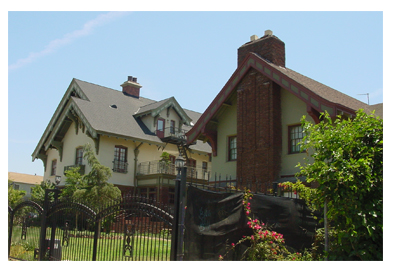 was designed and situated so that family members could easily move back and forth between the two residences within in a single unified ‘compound’.
The MSIA purchased the two properties, which had been subdivided into separate parcels over time, in 2002 and 2009 respectively. The much larger and impressive MacGowan home took six years for the MSIA to restore, with the Briggs restoration just wrapping up in the next couple of months after two years of exacting work. Now the MSIA is reopening the home for an “after” tour (see ad) after which the Briggs residence will serve as housing for MSIA staff, and members and be closed to the public so don’t miss this rare opportunity!
The Briggs home follows along the lines of the larger MacGowan residence’s Alpine Craftsman style with Tudor Revival influences – both built within months of each other by the same architect per a unified plan. The two homes were designed by the celebrated firm Hudson & Munsell who were also responsible for the Guasti Villa, the Hall of Justice, the former Hall of Records, and what is now the Los Angeles County Museum of Natural History.
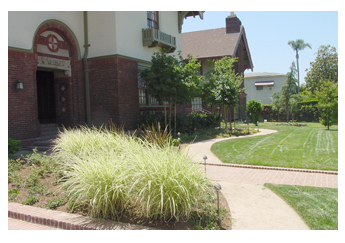 As part of the restoration project, the MSIA has broken down the intervening wall that went up in the mid-20th century between the two homes and has re-conjoined the two properties and grounds into their original configuration. Such estates consisting of two-related-households by the same architect in restored condition are extremely rare in Los Angeles, so the October tour is a special treat.
MSIA project manager Mark Lurie explains that the Briggs house needed everything – foundation work, new HVAC, floors and painting. In the words of the city housing inspector, the building was in really bad shape but had “good bones”. Few documentary photos exist to inform the restoration process. The MacGowan house proved some guidance but, as the master house, was designed with much more elaborate wood, tile and lighting features. At one point the Briggs home had become a women’s institution, and then was purchased by the Chang family in the 1960s for conversion to the Puritan religious university.
In restoring the Briggs residence, the MSIA applied many of the same techniques used in the MacGowan mansion,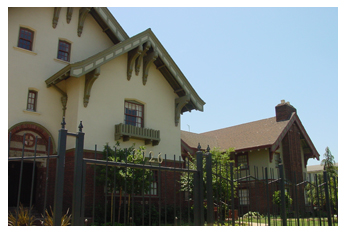 the latter having won a historic preservation award for the architect, Drisko Studio Architects with the late Martin Weil also advising on the project. The orientation of the two homes toward one another was reestablished with a central tile fountain resurrected and a loggia opened up. In touring the two homes on October 3rd, visitors will experience what would have been the original design of the family compound.
According to Lurie, the MSIA recognizes its responsibility to serve as a community resource for historic preservation. Lurie explains that during tours of the MacGowan, the MSIA staff have seen visitors down on their hands-and-knees, closely inspecting tile and molding, for techniques they can apply to their own restoration projects. The architects and contractors who worked on the Briggs restoration will be available on October 3rd for questions. Light refreshments will be served during this free tour.
Saving Bank of Tokyo
- Details
- Category: Architecture
- Published on Saturday, 07 April 2012 15:16
- Written by Laura Meyers
A Remnant of Jefferson Park’s Japanese American Heritage
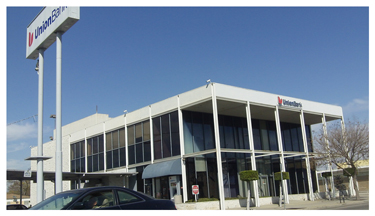 The Bank Of Tokyo building (currently the Union Bank) at the corner of Crenshaw and Jefferson has historic roots in the Japanese American community.This mid-century modern building designed by a pair of noted architects, Tosh Terasawa and Arthur O’Leary, was erected to remedy the Japanese Americans’ quest for financial equality in the face of racism, after they were resettled in the Jefferson Park community from the internment camps of World War II. Jefferson Boulevard had become a thriving business corridor, catering to the Japanese American community during the late 1940s until well into the 1980s.
When this historic building was threatened with complete demolition in order to make room for a parking lot for the development of a Fresh & Easy, the West Adams Heritage Association, WAHA and others objected, and began a series of meetings from August through October with representatives from CIM and West Angelus Community Development Corp. (the developers), Fresh & Easy (tenants), Council District 10, and United Neighborhoods Neighborhood Council (UNNC). After months of negotiations and meetings, the community was able to reach an agreement with the developers whereby a Fresh & Easy grocery store and a small bank branch building will be erected, and the frontage portion facing Jefferson (about half the building) of the existing Bank of Tokyo will be retained and rehabilitated.
The compromise balances the neighborhood’s desire for a new development at the long-vacant corner of Crenshaw and Jefferson, near the new Expo Line light rail train station, with historic preservation and design that is compatible with not just the adjacent community but also with “New Urbanism” goals of pedestrian-activated streets and transit-friendly development.
“The adaptive reuse of the building will also enhance the overall project on the site,” said WAHA Board member Eric Bronson.
In its appeal papers, WAHA wrote that “The Bank of Tokyo building represents a still-standing piece of community fabric in a neighborhood where much has been demolished. It is reflective of a time both past and present of a neighborhood filled with diverse culture. It is important to work toward goals that ensure the Japanese-American community’s history in Jefferson Park, as expressed through physical structures, is not erased.“
More Articles...
- The Durfee Mansion at St. John of Gods
- Paul Revere Williams
- Golden State Mutual Life Insurance Building a Historic-Cultural Monument
- Jefferson Park HPOZ Update Oct 2010
- The Kurtz Residence
- The Lucy E. Wheeler, Greene and Greene Residence
- The Guasti Villa
- Jefferson Park. Preserving It's Heritage
- "This Old House" magazine sites West Adams as Cal. Best Place to buy an old house.
- The Helen & Fredrick Booker Residence
Categories
-
Architecture
IF ONLY WALLS COULD SPEAK!
 People often think of history as an impersonal collection of facts and dates, a dusty inventory...
-
Our History
BRIDGET "BIDDY' MASON: Founder of the First African American Methodist Church FAME
 Originally posted on blackdoctor.orgWhen we talk about Black History, we hear a lot of names over...
-
In Memory Of
Barbara Morrison Celebrated Jazz Singer Dies at 72
 Barbara Morrison, a legendary singer in the Los Angeles jazz and blues music community, has died....
Yesterday15
Week60
Month253
All990355
Currently are 21 guests and no members online
Kubik-Rubik Joomla! Extensions